
In-Vitro Population Bioequivalence (PBE) Testing Using Particle Size Analysis
For locally acting nasal spray and nasal suspension products, particle and droplet size distribution is one of the key in-vitro measures regulators use to assess bioequivalence between a generic and its reference product. Under the US FDA framework, Population Bioequivalence (PBE) is used to compare both the average and variability of test versus reference results for applicable products.
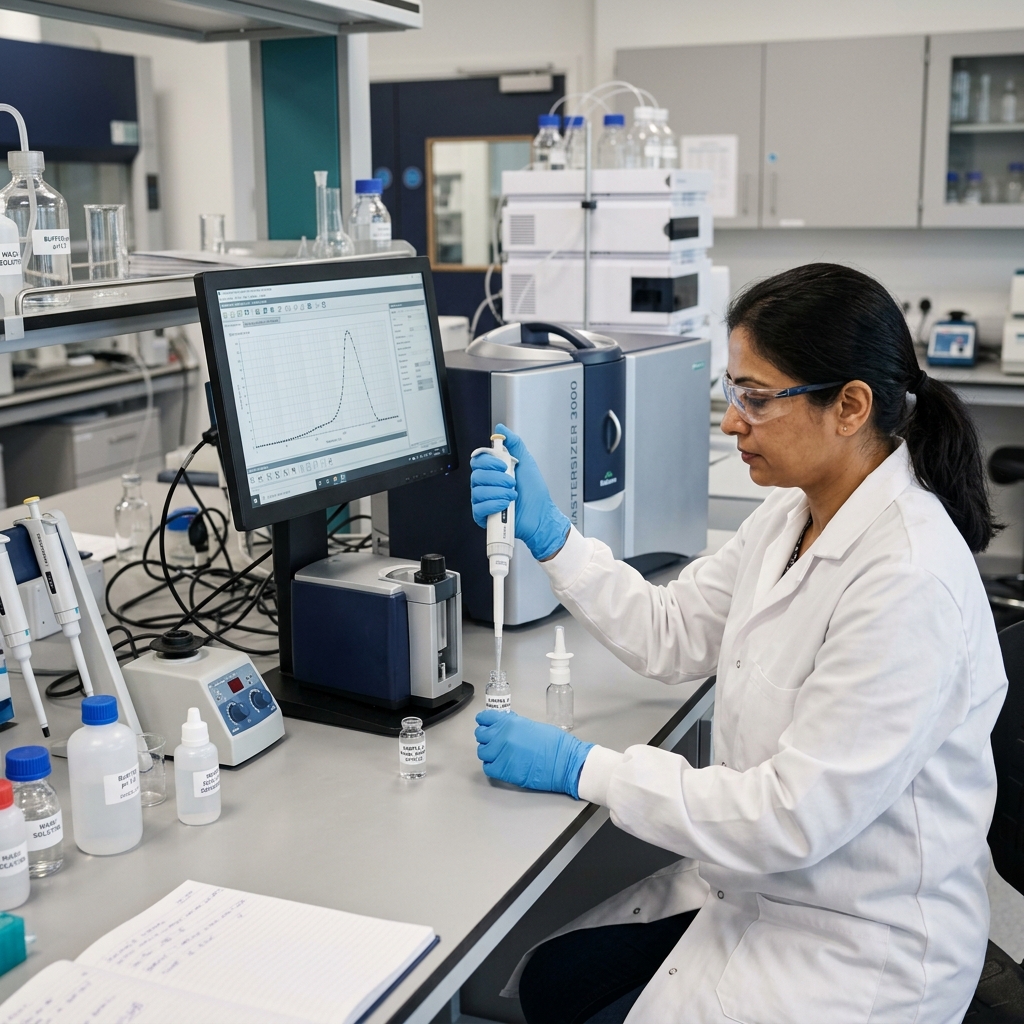
DALPL's Pharma Testing Division performs particle and droplet size distribution testing by laser diffraction on a Malvern 3000 particle size analyser, supporting in-vitro bioequivalence programs built around the PBE approach.
Why Particle Size Data Matters for Nasal Bioequivalence
For locally acting nasal products, particle and droplet size distribution can influence where and how the formulation is deposited and is therefore an important part of comparative product assessment.
Particle & Droplet Distribution
Characterizes the size distribution of particles or droplets generated by the nasal formulation and supports comparative assessment of test and reference products.
Population Bioequivalence
Under applicable US FDA approaches, PBE evaluates both the average performance and variability of test versus reference particle-size results.
In-Vitro Bioequivalence Support
Particle-size data can form part of an in-vitro bioequivalence strategy for appropriate locally acting nasal spray and suspension products.
What We Test
Droplet & Particle Size Distribution
Laser diffraction measurement of total droplet and particle size distribution using the Malvern 3000 particle size analyser.
Reported Parameters
Results are reported using standard distribution parameters:
- D10 — particle or droplet size below which 10% of the measured distribution lies
- D50 — median particle or droplet size
- D90 — particle or droplet size below which 90% of the measured distribution lies
- Span — distribution-width indicator derived from D10, D50 and D90
PBE-Supporting Data
Generate particle-size data suitable for Population Bioequivalence statistical analysis where required by applicable FDA product-specific guidance for nasal spray and suspension products.
Scope Note
This service concerns total particle/droplet size distribution by laser diffraction. It is not equivalent to drug-specific particle sizing by microscopy or MDRS, and it does not represent aerodynamic particle size distribution by cascade impaction.
Laser Diffraction Analysis Using Malvern 3000
DALPL performs particle and droplet size distribution analysis using laser diffraction on a Malvern 3000 particle size analyser. The measurement provides a distribution profile rather than a single particle-size value, supporting comparative formulation assessment and PBE-oriented data analysis.
Measure the distribution. Compare the populations. Support the bioequivalence strategy.
Data are generated suitable for PBE statistical analysis where applicable.
From Particle Size Measurement to Bioequivalence Assessment
The analytical workflow connects particle-size measurement with the broader bioequivalence strategy for applicable nasal products.
Define the Product & Regulatory Pathway
Identify the nasal spray or suspension product and the applicable market-specific bioequivalence approach.
Characterize Particle / Droplet Size
Measure the total particle or droplet size distribution using laser diffraction.
Report Distribution Parameters
Generate D10, D50, D90 and span values for comparative evaluation.
Prepare PBE-Suitable Data
Structure the particle-size results for Population Bioequivalence analysis where the applicable FDA product-specific guidance calls for this approach.
Support the Bioequivalence Program
Use the analytical results as part of the overall in-vitro bioequivalence strategy for the applicable product and market.
How the Major Regulators Differ
Population Bioequivalence is not a universal statistical framework across all regulatory jurisdictions. The study strategy should be designed around the requirements of the target market.
US FDA
For applicable nasal spray and suspension products, FDA product-specific approaches can use Population Bioequivalence analysis of particle-size data as part of an in-vitro bioequivalence pathway. The FDA's broader nasal aerosol/spray guidance identified in the source is a draft guidance, while individual product-specific guidances may be current.
EMA
EMA's current Guideline on the Pharmaceutical Quality of Inhalation and Nasal Products is effective from 1 February 2026. The source describes an approach based on a standard 90% confidence interval test on the geometric mean ratio, rather than the FDA's Population Bioequivalence framework.
TGA — Australia
The reviewed source indicates that TGA adopts an international bioequivalence guideline rather than maintaining a separate PBE statistical framework. The source did not independently confirm the TGA page, so do not present a detailed TGA-specific statistical requirement beyond this distinction.
Health Canada
The reviewed source identifies Health Canada's steroid nasal-products guidance as a relevant reference, while noting that the located version is from 2011 and may be outdated. Do not present it as a universal current requirement for all nasal products.
One analytical study strategy does not automatically satisfy every market. Global filing strategies should account for jurisdiction-specific bioequivalence expectations from the outset.
Why DALPL
Delivering high-accuracy impurity profiling with uncompromised regulatory integrity.



Frequently Asked Questions
Talk to Us About Your In-Vitro Bioequivalence Program
Discuss your nasal spray or suspension product, particle-size testing requirements and target-market bioequivalence strategy with the DALPL Pharma Testing Division.