
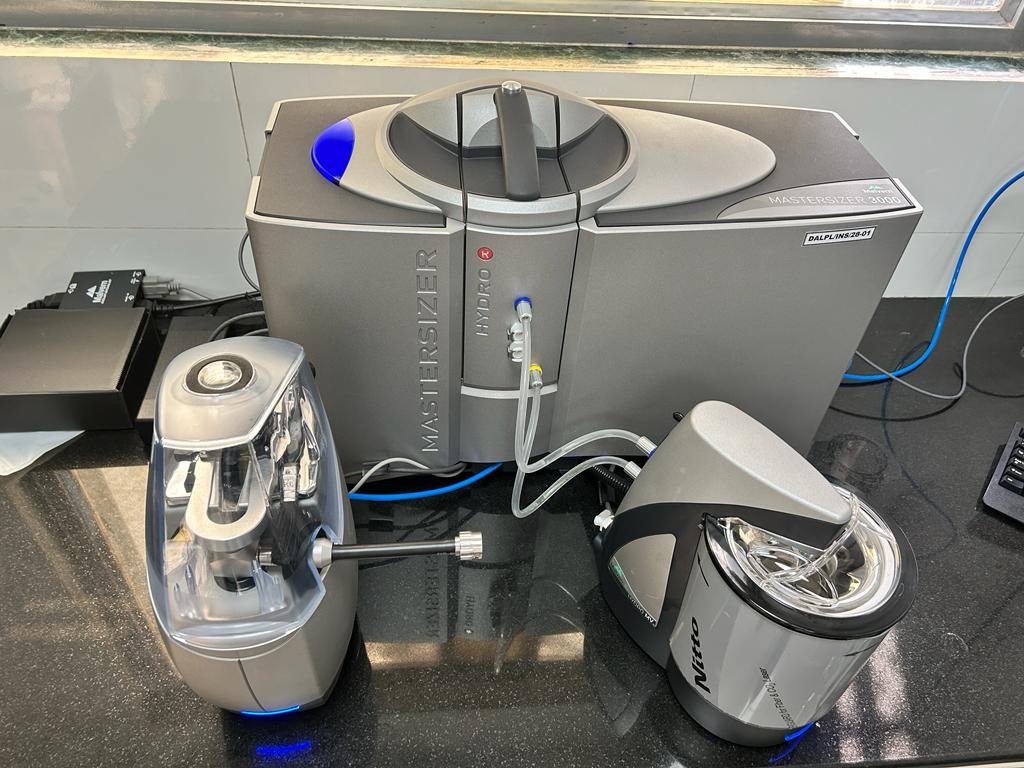
Particle Size Analysis Using Malvern 3000
Laser diffraction particle size analysis for pharmaceutical raw materials, APIs, excipients and formulated dispersions, supporting formulation development, batch consistency and specification-setting.
Why Particle Size Matters
Particle size can influence key pharmaceutical product characteristics including dissolution rate, bioavailability, content uniformity, stability and manufacturability. Where particle size affects product performance, ICH Q6A recognises particle size distribution as a specification test for drug substances and drug products. For inhalation and nasal products, current EMA guidance places specific emphasis on how particle size is controlled during manufacture.
DALPL provides laser diffraction particle size distribution analysis using a Malvern 3000 particle size analyser, aligned with USP <429> and ISO 13320:2020.
What We Test
DALPL's particle size analysis capability covers:
Raw Materials & APIs
Particle size characterization of pharmaceutical raw materials and active pharmaceutical ingredients.
Excipients
Particle size characterization of excipients used in pharmaceutical formulations.
Suspensions & Dispersions
Particle size distribution analysis for oral, nasal, ophthalmic and topical formulations.
Formulation Development
Particle size data supporting formulation development and evaluation.
Batch Consistency
Particle size monitoring to support consistency across batches.
Specification Support
Particle size data supporting specification-setting where particle size affects product performance, in line with ICH Q6A.
Laser Diffraction Analysis
DALPL performs particle size distribution analysis using laser diffraction on a Malvern 3000 particle size analyser.
The analysis is performed with reference to:
The resulting particle size distribution is reported using key parameters including D10, D50, D90 and span.
Key Particle Size Parameters
Particle size analysis provides a defined distribution profile rather than relying on a single particle-size value.
Applications & Development Support
Particle size analysis can support pharmaceutical development and product-control requirements across multiple applications.
Characterize particle size of pharmaceutical raw materials and active pharmaceutical ingredients.
Evaluate particle size characteristics of pharmaceutical excipients.
Generate particle size data for oral, nasal, ophthalmic and topical suspensions and dispersions.
Monitor particle size distribution as part of batch consistency evaluation.
Support particle size specifications where particle size has an impact on product performance, consistent with ICH Q6A.
Support particle size-related formulation development for inhaled and nasal products within the quality expectations established by current EMA guidance.
Regulatory & Compendial Framework
DALPL's particle size analysis is positioned against the following technical and regulatory references:
Relevant where particle size affects product performance and is established as a specification test.
The compendial chapter governing light-diffraction particle size measurement.
The applicable international standard for laser diffraction particle size analysis.
Effective from 1 February 2026, with specific expectations around particle size control for inhalation and nasal products.
Regulatory status note: The FDA MDI/DPI quality-considerations document referenced in the technical review is a draft document and is not presented as a binding implementation requirement.
Particle Size vs APSD
A Defined Analytical Scope: This service focuses on laser-diffraction particle size characterization of raw materials, excipients and formulated dispersions. It is distinct from aerodynamic particle size distribution (APSD) testing of inhaler or nasal-spray aerosol plumes, which uses cascade impaction as a separate analytical methodology.
Intended analytical context:
- Raw materials
- APIs
- Excipients
- Suspensions
- Dispersions
A separate analytical methodology:
- Inhaler / nasal aerosol plume
- Cascade impaction
Why DALPL
Malvern 3000 Laser Diffraction
Particle size distribution analysis using the Malvern 3000 particle size analyser.
USP <429> & ISO 13320:2020
Testing aligned with established compendial and international laser-diffraction particle-size methods.
Pharma Testing Capability
Particle size analysis is delivered through DALPL's dedicated Pharma Testing Division.